Gravity does the talking

by Shane L. Larson

Obi-wan Kenobi, in perhaps one of the most famous utterances in cinematic history, claimed that the Force “is an energy field, created by all living things. It surrounds us, it penetrates us, it binds the galaxy together.” This propagated rapidly through popular culture when it was realized that Obi-wan must have been talking about duct tape, which after all has a light side, a dark side, and also binds our world together.

The famous utterance of Ben Kenobi's description of the Force (from "Star Wars").

The famous utterance of Ben Kenobi’s description of the Force (from “Star Wars”).

But an astute citizen of the Cosmos may grow curious at Kenobi’s observation, and ask “what does bind the galaxy together?” As it turns out there is a force that penetrates the fabric of the Universe, in a way it is the fabric of the Universe. We call it gravity.

Many of us have heard the idea that there are four fundamental forces in Nature: gravity, the electromagnetic force, the weak nuclear force, and the color force (the “strong nuclear force” is a faint bit of the color force that “leaks” out of atomic nuclei to be detectable by our experiments). Why is gravity The Force? Why not the others?

The four fundamental forces of Nature emerged after the Big Bang, as the Universe cooled and expanded.

The four fundamental forces of Nature emerged after the Big Bang, as the Universe cooled and expanded.

In order to fill the Cosmos, a force must be a long range force — the Cosmos is a BIG place!  The weak nuclear force and the color force are short range — they act very strongly over very tiny distances, in atomic nuclei and in the nuclear particles that comprise nuclei. The electromagnetic force is a long range force, but it acts in the presence of electrically charged particles, which come in two flavors — positive (+) and negative (-). It is easy to make separate positive and negative charges and to locally generate strong electromagnetic forces (lightning is a prime example from Nature), but by and large the Cosmos is electrically neutral — opposite charges are attracted to each other, and they quickly neutralize and cancel each other out, leaving no free charge behind.  Gravity is also a long range force, but it has only one kind of “charge,” which we call “mass.” There is no negative mass, so gravity cannot be shielded or canceled, and it acts over vast distances.

Gravity is the only game in town when it comes to forces acting on cosmic scales, despite being so incredibly weak.  I can see the skepticism on your face!  I said gravity binds the Cosmos together, and in the same breath said it was incredibly weak!  Whatever do I mean?

I tried as hard as I could to break the apple in two!

I tried as hard as I could to break the apple in two!

I mean that gravity is weak compared to the other forces of Nature, a fact you can easily demonstrate in your kitchen. Pick up an apple.  What is holding an apple together?  It is mostly intermolecular forces between the molecules that make the apple up, and those forces are electromagnetic in nature.  Now,using your bare hands, try to break the apple half.  Not so easy, is it?

Using the chemical energy from some Dr. Pepper, I can overcome the gravitational pull of the entire planet.

Using the chemical energy from some Dr. Pepper, I can overcome the gravitational pull of the entire planet.

Now, stand up and jump up in the air. How high did you get? Even if it was just a couple of inches consider this fact: you were able to momentarily over come gravity.  Using a little bit of chemical energy, gleaned from that rabbit food you ate at lunch (perhaps an apple you ate), you were able to overcome the gravitational pull of the ENTIRE EARTH!  Gravity is weak (and you are strong).

While these kinds of deep machinations are fascinating questions into the deep nature of Nature, you might still be scratching your head wondering what good is this knowledge? The first widely understood law of Gravity was Newtonian gravity, described by Isaac Newton in 1687.  It was used almost immediately to begin describing the motion of heavenly bodies, but by and large the world went about its business more or less oblivious to this stunning achievement of the human intellect.  The practical application of Newtonian gravity, using it for something that humans build or use, was not for almost 270 years: in 1957, the Soviet Union launched Sputnik, requiring a detailed understanding of orbital dynamics, which is derived from Newtonian gravity.  By a similar token, Albert Einstein wrote down the modern description of gravity, general relativity, in 1915. There were immediate applications of general relativity to astrophysics (a trend that has only grown since), but practical applications to human affairs did not seriously arise until the late Twentieth Century.  Let me tell you some stories about how gravity, general relativity, is changing our world.

GRACE.  Our society is engaged in much teeth-gnashing about the nature of the Earth’s changing climate, but most scientists are doing what scientists do best — they put their heads down, they collect data, then they figure out what the data is telling them.  Of particular importance to climate studies is the hydrological cycle on Earth.  Gram for gram, water is a bigger player in thermodynamics than any other substance on Earth. It is extremely effective at cooling and heating, which is why you use it to cool off in the summer and warm up in the winter!  The movement of water on Earth, in the oceans, the clouds, the rivers, and the atmosphere has enormous impacts on climate worldwide.  But the hydrosphere is HUGE! We can’t possibly hope to monitor water levels and water flow in lakes and rivers and oceans worldwide by placing individual sensors.  So how are we to learn about the water on Earth and how it moves and changes?  The answer is we use gravity.

(L) Satellite geodesey monitors the orbit of a satellite to understand the underlying source of gravity. (R) The GRACE geodesey system uses two satellites keeping track of each other using a microwave link.

(L) Satellite geodesey monitors the orbit of a satellite to understand the underlying source of gravity. (R) The GRACE geodesey system uses two satellites keeping track of each other using a microwave link.

Satellite geodesey can make precision measurements of the Earth’s gravitational field. As a satellite flies over the Earth, the changing mass below the satellite changes the strength of gravity, which alters the satellite’s trajectory in its orbit.  We monitor the orbit to know how the gravity (and the mass creating the gravity) is changing!  In 2002, NASA launched a mission called GRACE (Gravity Recovery and Climate Experiment), consisting of two satellites flying about 220 km apart, monitoring each others’ orbit using a microwave signal.  For over 5 years, GRACE monitored the Earth’s gravitational field and was able to see how it changes as water and ice move around our planet.  Just one example is shown below, illustrating how the gravity in the Amazon basin goes up and down with the coming and going of the rainy season.  Similar results illustrate the changing ice around the planet, particularly in the Arctic and Antarctic.

GRACE geodesey is sensitive enough to detect the change in gravity over the Amazon basin as the rainy season comes and goes.

GRACE geodesey is sensitive enough to detect the change in gravity over the Amazon basin as the rainy season comes and goes.

GPS.  phoneGPSPerhaps the most ubiquitous use of gravity in your everyday life is the global positioning system. Once relegated to navigation on planes and automobiles, the advent of GPS built into smartphones has enabled an explosion of location services that allows you to find friends, local restaurants, comic book stores, and concert venues in unfamiliar cities.

Fundamentally, GPS works by triangulation.  Satellites send out timing signals that are received by your smartphone or GPS navigator. The signals are broadcast in synch with one another. This means that if you are an equal, fixed distance from two satellites, you’ll get the same time from both (this is like using headphones — the sound from the L and R side are synchronized so you hear all the right parts of the song and the same time!).  If you are closer to one satellite, then you receive a time from that satellite sooner than a distant satellite (this is like watching a track meet from the stadium — runners hear the starting gun before you do, because they are closer).  Your navigator compares your local time to the time received from the satellites, allowing the determination of distance to each satellite. Since the position of each satellite is known, your location can be computed.

GPS triangulates your location by comparing the received time from multiple satellites.

GPS triangulates your location by comparing the received time from multiple satellites.

The satellite timing signals must be modified, using general relativity.  Why?  The satellites are much higher in the Earth’s gravitational field than you are, and general relativity tells us their clocks tick at a different speed. How much different? Over the course of a day, the general relativity correction to the clock times is about 38 microseconds — 38 millionths of a second!  You may be thinking “But that is so tiny!”  Yes it is tiny, but GPS works based on how far light travels in a given time.  In 38 microseconds, light travels 11.4 kilometers (7 miles)!  When you are trying to find a sushi restaurant, or the soccer field for your kids next game, 11 kilometers is a long way off!

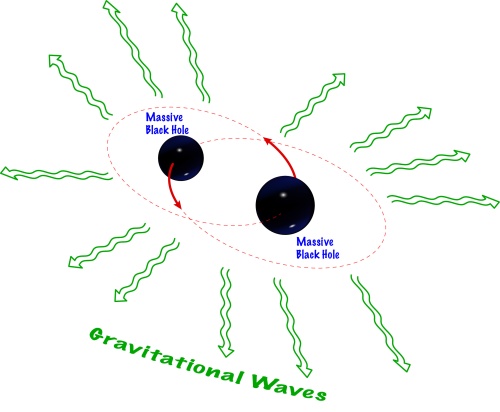
Gravitational waves. ein_1920Let me tell you one last story, not about the practical uses of gravity, but about our dream of using gravity to reveal the secrets of the Cosmos.  In 1918, while exploring the implications of general relativity, Einstein discovered that there exists a kind of gravitational radiation, where the gravity from an astrophysical system carries energy away and into the far reaches of the Universe.  He calculated the strength of this radiation, and very quickly decided that it would be exceedingly difficult (if not impossible) to experimentally measure.

But fast-forward the blu-ray to today, and we have technology at our disposal that Einstein could never have imagined — high precision, high power lasers; GPS positioning systems to accurately locate anything anywhere on the planet; high performance computers capable of performing billions of computations per second; a globe girdling network that passes information from one continent to another as easily as one might shout down the hallway to a colleague; and most importantly, a vast community of scientists well-trained and well-versed in wresting secrets from Nature, the best minds our planet has to offer. You add that all together, and we find ourselves in the land of Einstein’s dreams, poised to measure the faint echoes of gravity bathing the Earth from distant corners of the Cosmos.

Nearly a century of thinking on the matter of gravitational radiation has coalesced around a magnificent machine called LIGO — the Laser Interferometer Gravitational-wave Observatory.  Using lasers shining up and down 4 kilometer long beam arms, a new generation of astronomers — gravitational wave astronomers — hope to detect the dance of neutron stars and black holes spiralling toward collision, the constant drone of young pulsars spinning down into their final rest in the stellar graveyard, and maybe (if we are lucky) the cataclysmic supernova explosion of a star dying, a process that synthesizes most of the atoms that comprise what we are all made of.

The LIGO Observatory at Livingston, LA. There is a companion observatory in Hanford, WA.

The LIGO Observatory at Livingston, LA. There is a companion observatory in Hanford, WA.

Gravitational wave astronomy is a way of asking anew the questions about who we are and what our place in the Cosmos is; it is a way of once again indulging in the unique gift to our species, an insatiable sense of curiosity and wonder.  But are there practical outcomes from this remarkable feat of human imagination? Perhaps not obvious ones, because the practical outcomes were not the driving force in the creation of the experiment. But as with all great feats of science and engineering, from the Manhattan Project to Apollo to LIGO, there are always beneficial outcomes.  Already LIGO’s technology is pushing the frontiers of optics and laser technology, environmental monitoring, and computer network capabilities.  But changes you see in your living room may be 7 or 70 or 270 years away.

This has always been the case for gravity; the timescale is simply a matter of how creative our engineers and scientists get!

Humanhenge — Marking Time in the Modern World

by Shane L. Larson

The other morning, when she was trying to decide what to wear for the day, my daughter said to me, “Is it cold outside?” Then, without missing a beat, she says “Never mind,” and picked up an iPhone and checked the current weather conditions. This brought to mind a vivid memory from my childhood of me asking the same question of my mother, and her saying “Go out and check!”  She had a rock on her porch; if it was wet it was raining, if it was white it was snowing, if it was hard to see it was foggy, and so on.

Far be it from me to eschew modern technology; it can do awesome things!  But it strikes me that if there is any truth about modern society, it is that it is entirely possible to live your life looking through the electronic portal of digital technology, rather than by looking out the window.

My schedule is kept by a modern calendar application, accessible from my phone. This is modern progress.  Sigh.

My schedule is kept by a modern calendar application, accessible from my phone. This is modern progress. Sigh.

This was not always the case, of course.  Our forebears had to pay attention to the world, literally because it was a matter of life and death. Today, if strawberries are out of season in the northern US, no worries — your local store is shipping you some from far away, the cogs of the modern economy meeting your every whim.  But hundreds and thousands of years ago, crops had to be planted in time for the life giving rains, and harvest had to be brought in before fall frosts destroyed the yields that had to last through the winter.  Before quartz watches, before Greenwich Mean Time, and before Google Calendar, people still had to know what time of year it was.

So what did people do before the world worked on linked times and calendars? They watched the sky! The sky is filled with a regular clockwork of motions that ticks off the seconds, days, and aeons as precisely and regularly as the finest timepiece humans have ever made. The motions in the sky are a combination of the Earth’s orbital motion around the Sun, the spin of the Earth on its axis, and the fact that the North Pole of the Earth is not pointing straight up from the orbit.

One observational consequence of these three facts is that the Sun’s position in the sky changes over the course of a year. Each day it rises and sets at a different point on the horizon, and it tracks across the sky along a different pathway.  The equinoxes are the days during the year when the Sun rises and sets directly in the East and West. The solstices are the days during the year when the Sun rises and sets at the point furthest North and South on the horizon.

The ever-changing rise and set position of the Sun along the horizon can be used as a calendar. One of the most famous examples is the Shungopavi horizon calendar of the Hopi in the American southwest, shown below.  As the sunrise marches north and south along the horizon, its passage by certain landmarks indicates times of planting, harvest, and cultural ceremonies.  While you likely have no need for a horizon calendar, it can be fun to construct one via sunrise observations at your own home, like mine in Paradise, Utah, also shown below.

Example horizon calendars. The Hopi Shungopavi horizon calendar (top), and my personal horizon calendar for Paradise, Utah (bottom).

Example horizon calendars. The Hopi Shungopavi horizon calendar (top), and my personal horizon calendar for Paradise, Utah (bottom).

There are many ancient sites around the world where the rising and setting of the stars and Sun are aligned over carefully placed stones and architectural structures.  Stonehenge on the verdant Salisbury Plain, and the great Anasazi kiva Casa Rinconada in Chaco Canyon, and the Great Medicine Wheel on top of Wyoming’s Bighorn Range.  All of these sites, and many more besides, bespeak of the intimate knowledge our ancient ancestors had about the sky.

Ancient astronomically aligned sites. (L) Stonehenge, (C) Casa Rinconada, (R) Bighorn Medicine Wheel.

Ancient astronomically aligned sites. (L) Stonehenge, (C) Casa Rinconada, (R) Bighorn Medicine Wheel.

Manhattanhenge, looking down 42nd Street.

Manhattanhenge, looking down 42nd Street.

Sometimes modern landscapes align with the celestial clockwork, possibly by design but often by accident.  Consider the island of Manhattan. The island sits in the mouth of the Hudson River, canted diagonally to the north-south direction.  When it was first settled, the streets were laid out willy-nilly, in the usual haphazard organic way of ancient cities.  The expanding maze of twisty little streets that all look the same was abruptly ended by the Commissioners’ Plan of 1811, which established a grid plan for the growth of the city.  The grid was laid out with the long northish-southish thoroughfares running parallel to the coastline of the island.  As a consequence, the cross-streets running eastish-westish are all canted roughly 25 to 30 degrees to the east-west direction.  As it turns out, that is just the right tip for all the streets to be close to lining up with the sunrise and sunset directions on the Summer Solstice!  This was famously noted about ten years ago by Neil deGrasse Tyson, who dubbed the phenomenon “Manhattanhenge.”

The street grids for Manhattan (L) and for Chicago (R). The geometry of the streets determines when you will have a well placed sunrise or sunset to make a cityhenge.

But you don’t have to travel all the way to Manhattan to enjoy modern astronomical alignments.  Many towns and cities are laid out on a grid system.  For grids lined up on a north-south and east-west system, magic happens every March and every September, on the equinoxes.  For instance, in the city of Chicago, the streets are laid out (more or less) on a rectangular grid aligned to the compass points, and a “Chicagohenge” can be photographed on the Spring Equinox in March, and on the Fall Equinox in September!

Examples of Chicagohenge [Images from Ken Ilio's Uncommon Photographers].

Examples of Chicagohenge [Images from Ken Ilio's Uncommon Photographers].

No matter where you are, there is probably an opportunity to use your city as a henge for photographing the ever-changing motion of the Sun.  Even small towns, like Vankleek Hill, Ontario.  The town is about half-way between Ottawa and Montreal, and has a population of only about 2000 people. The grid is laid out canted to the compass points, roughly parallel to the drainage from Lake Ontario into the Gulf of Saint Lawrence.  It’s just enough to line up with the Sun on the solstices, captured in this image by Gabriel Landriault.

(L) The street grid in Vankleek Hill, Ontario is canted about 20 degrees to an east-west line. (R) A summer solstice along Vankleek Hill's streets [image by Gabriel Landriault].

(L) The street grid in Vankleek Hill, Ontario is canted about 20 degrees to an east-west line. (R) A summer solstice along Vankleek Hill’s streets [image by Gabriel Landriault].

The Vankleek Hill picture hints at another point in this whole game.  The streets in Vankleek Hill are only canted 20 degrees or so from east-west, whereas the Sun is a bit farther north on the solstice, so is not perfectly aligned in this case.  But there is some day during the year when it is aligned!  This is a subtlety that was hinted at by our horizon calendars — the Sun is always on the move, marching up and down the horizon.  On the soltices and the equinoxes it is in a definite, predictable location on the horizon.  But with some careful planning, observations, and simulation (such as with a planetarium simulator like Stellarium), you can figure out when the sunrise and sunset will line up with the streets in your own town.

An example simulation of sunrise and sunset from the Adler Planetarium on the Spring Equniox, using StarryNight desktop planetarium software.

An example simulation of sunrise and sunset from the Adler Planetarium on the Spring Equniox, using StarryNight desktop planetarium software.

The truth is, it is not a life and death matter if I don’t pay attention to the daily motion of the Sun and use that information to lead a subsistence, agrarian lifestyle.  I have a calendar, the Farmer’s Almanac, and Google to tell me when to plant my snap peas.  I can really just do astronomy for fun — because it is cool, and it lets me capture some beautiful pictures that I can use to impress my friends and woo members of the opposite sex.

The Spring Equinox is just around the corner!  So go out with your cell phone and catch a sunrise or a sunset, directly down your nearest East-West street. Make sure you tweet the picture to the rest of us, so we know it is spring and can start to think about planting our gardens; strawberry season is on its way!

Rocket Science in my Pocket

by Shane L. Larson

When I was growing up, the end-all toy of toys was a Remco utility belt.  In accordance with my secret personas and the innermost inscrutable desires of my soul, I had two: a Batman utility belt, and a Star Trek utility belt.

(L, upper) A Remco Batman Utility Belt. (L, lower) A Remco Star Trek Utility Belt. (R) A modern tricorder toy.

(L, upper) A Remco Batman Utility Belt. (L, lower) A Remco Star Trek Utility Belt. (R) A modern tricorder toy.

I’ve always been a Trekker at heart, so the Star Trek utility belt was my favorite, mostly for the tricorder.  Today, I have replicas of all the classic elements of this old Remco belt — phaser, communicator, and tricorder — but the tricorder is still my favorite.  I love the tricorder because it is a small device, easily carried, connected to all the knowledge of the world, and able to probe the world around you with a suite of sensors and gizmos — a tricorder can do anything. At the time Star Trek was created, and even up through the most recent Star Trek series on television, tricorders were science fiction.

My iPhone 4S --- a modern day tricorder.

My iPhone 4S — a modern day tricorder.

But tricorders are no longer science fiction.  There is an X-Prize competition to make a working medical tricorder a reality. More importantly, many of us are walking around with tricorders in our pockets right at this very moment (are you reading this blog on one?); we call them smartphones. Smartphones are awesome devices. They are smaller than the tricorders of Star Trek, but they have built into them the capabilities of communicators, and they can connect to the worldwide digital library of human knowledge that we call “the Internet.” Most importantly they are outfitted with a suite of physical sensors that can be used to understand the world: a camera, a light sensor, microphones, a magnetometer, and an accelerometer.

It may be easy to ignore these little gadgets, dismiss the sensor suite as features (toys) for complete uber-nerds.  The data they produce may seem somewhat esoteric, and obtuse, far removed from the things you care about in everyday life. But these sensors provide you — an average citizen of the Cosmos — with a remarkable and astonishing power. YOU can use these sensors to illuminate the secrets of Nature, to probe the laws of physics in your immediate environment. These are the same laws of physics that govern distant galaxies, shape avalanches in the Rocky Mountains, explain the inner workings of your Kitchen-aid Mixer, drive the biorhythms of your cardiopulmonary system, and produce exploding garbage trucks on movie sets.  You live in a magical time in history, when the tricorder in your pocket lets you see the world around you anew, to ask questions like: how is my voice different from Barry White’s? Why is this light yellowish looking and this light is bluish looking? How high of a shelf can an egg fall off of without serious damage occurring? There are a variety of apps for your phone that will let you probe the various sensors.  Let’s look at some awesome capabilities that those apps enable.

ACCELERATION. Acceleration is the rate at which your motion is changing — if you are changing direction or speeding up or slowing down, you are accelerating.  Our perception of motion naturally has three possible directions: up/down, left/right, and forward/back, and your phone has 3 sensors (“accelerometers”), one for each of these directions. If I put my phone in my pocket, and start walking, sometimes the phone is moving up, but then changes direction and is moving down.  The gait of my walk means my hips twist and turn, so sometimes the phone is moving left and sometimes right.  The lines shown here represent the three changing motions of the phone as I walk across the room.  I can also find out what happens to my phone when I drop it on the (carpeted) floor.  The sudden sharp accelerations are the phone suddenly going from moving very fast to moving hardly at all (read: SMACK! Yes, I dropped my phone on the floor, just for you.).

(L) Acceleration profile of me walking across the room, phone in my pocket. (R) Acceleration of my phone hitting the carpeted floor, having been dropped from waist height.

(L) Acceleration profile of me walking across the room, phone in my pocket. (R) Acceleration of my phone hitting the carpeted floor, having been dropped from waist height.

Vibrations are easy to capture; if I lay my phone on a table, then sharply pound on it, the phone can sense the small bouncing motions, shown in the video here.  There are many uses for being able to measure acceleration.  You can capture other interesting graphs by running the sensors when you are a passenger in a car, when you ollie on your board, or by setting your phone on the washing machine when it is running.

Screen capture using Soundbeam app of a speaking voice. Video with audio here.

Screen capture using Soundbeam app of a speaking voice. Video with audio here.

SOUND. Sounds are a form of wave. Different sounds have different wave shapes. The shapes of those waves entering your ear is what allows you to distinguish different sounds from one another. It’s why your voice and my voice sound different from one another. The microphone on your phone captures sounds, and what it senses can be plotted to show you the wave shapes.  Sounds like the human voice have many different waves all added together, so the wave plots are jagged and non-uniform, rising and falling as we make words, change pitch and tone, and shape sound.

Screen shot using Soundbeam app of a whistle, a pure wave tone. Video of whistling different tones here.

Screen shot using Soundbeam app of a whistle, a pure wave tone. Video of whistling different tones here.

By contrast, some sounds are pure tones — a single wave that has a smooth repeating wave shape when plotted. A whistle is a good example (to the extent that one can maintain even pitch and tone when whistling).  Here is a movie of the waveforms when I am (attempting) whistling at different constant tones.  Low pitched sounds have wider wave shapes; high pitched sounds have narrower wave shapes.  When you hear a low pitch sound, fewer little wave bumps are entering your ear and impinging on your eardrums. When you hear a high pitched sound, lots of little wave bumps are entering your ear.

MAGNETIC FIELDS.  We are surrounded by magnetic fields. The Earth has a very prominent magnetic field that we have exploited for navigation for a millennium or more. We use magnetic fields to stick lottery tickets and children’s drawings to refrigerators. You’ve probably unknowingly encountered magnetic fields out in the world. Have you ever exited a parking lot, and had an automatic gate open as you approach it? These gates usually sense a magnetic field associated with the metal in your car.

Your phone uses the magnetometer as an electronic compass, but you can use those sensors to probe one of the first discoveries of modern physics — that electricity and magnetism are connected!  In the early 1800’s, physicists thought electricity and magnetism were two completely different things. Then in 1819, Hans Christian Ørsted discovered that electric currents could deflect magnets! This was a watershed discovery that was followed up by many others including Faraday, Ampere, Henry, and Maxwell.  The outcome was the first great unification in physics, of electricity and magnetism into a single theory called (remarkably!) electromagnetism. You can probe the same discovery as Ørsted using your smartphone. I was able to use my phone’s magnetometer to sense the power cord to my laptop, but you get dramatic results by moving your phone around a high power electrical device like your television set!

(L) Magnetometer reading as I push my tricorder toward the power cord to my laptop [which is SO Twentieth Century!]  Video here.  (R) Magnetometer reading as I move my tricorder around the back of my flat screen TV.  What is in there?  Video here.

(L) Magnetometer reading as I push my tricorder toward the power cord to my laptop [which is SO Twentieth Century!] Video here. (R) Magnetometer reading as I move my tricorder around the back of my flat screen TV. What is in there? Video here.

But there is a mystery here — I get a reading even if the television is off. What is in there?! I’ll need a screwdriver to find out… :-)  What else can you discover in your house with strong magnetic fields?

LIGHT. One of the most important tools in science, particularly in astronomy, is spectroscopy — the study of different colors of light emitted by different materials. Everything that we have ever seen in the Cosmos is comprised of combinations of 92 naturally occurring materials, that we call “elements.”  Each of these elements emits light in a characteristic set of colors, a fingerprint that uniquely identifies one element compared to another.

The visible light fingerprints ("atomic spectra") of all the known chemical elements. Each atom emits and absorbs these unique sets of colors, making it possible to identify them.

The visible light fingerprints (“atomic spectra”) of all the known chemical elements. Each atom emits and absorbs these unique sets of colors, making it possible to identify them.

It was a deep understanding of the spectra of the stars that allowed Cecilia Payne-Gaposchkin to brilliantly deduce in 1925 that the stars were mostly hydrogen and helium in her PhD thesis.

Cecilia Payne Gaposchkin, the first person to understand what the stars are made of.

Cecilia Payne Gaposchkin, the first person to understand what the stars are made of.

When you look at a lightbulb, or a star, you perceive a particular hue, a shade of color that your eye feeds to your brain. But if you pass that light through a prism, the light divides itself into a cacophony of colors that all mixed together to produce the hue you saw. You can break light up by passing it through a prism, or through a diffraction grating (modern diffraction gratings are thin, transparent plastic with hundreds of finely spaced grooves that allow it to behave very similarly to a prism when light passes through it).

My tricorder, Macgyvered into a spectrometer using instructions with the spectraSnapp application.

My tricorder, Macgyvered into a spectrometer using instructions with the spectraSnapp application.

My colleagues at the American Physical Society have just created an awesome and simple modification of your phone that will let you not just take pictures, but capture, measure and identify spectra of different light sources using your phone.  The app is called spectraSnapp.  The app includes instructions on how to MacGyver a simple attachment from construction paper, tape, and a piece of diffraction grating (which could be MacGyvered to any phone, not just an iPhone).  This makes it possible to capture very clean spectra, like those shown below.

Sample spectra taken with my tricorder. (L) The line spectrum from a common compact fluorescent bulb. (R) The continuous spectrum from a traditional incandescent bulb.

Sample spectra taken with my tricorder. (L) The line spectrum from a common compact fluorescent bulb. (R) The continuous spectrum from a traditional incandescent bulb.

If I use the analysis suite built into spectraSnapp, it would seem that I’m looking at the spectrum of a compact fluorescent bulb (but I knew that! :-) ), and that the bright lines I captured are the brightest lines in the spectrum of mercury.

The spectraSnapp analysis screen lets you compare your spectrum to reference spectra. It seems my spectrum looks a lot like a compact fluorescent bulb (L), and that there is mercury in it (R).

The spectraSnapp analysis screen lets you compare your spectrum to reference spectra. It seems my spectrum looks a lot like a compact fluorescent bulb (L), and that there is mercury in it (R).

The number of possible experiments and explorations you can do with this technology in your hand is limited only by what you can think to do.  Want to know how loud the neighbor’s ZZ Top Airband party is? There’s a sensor and app for that. Want to know how many g’s you pull in an express elevator to the 67th floor? There’s a sensor and an app for that. Want to know how “do not disturb” that new mattress really is if you jump on it? There’s a sensor and an app for that.

Technology and smartphones have transformed our world in unprecedented ways. Sure they give you something to do when you’re eating lunch at a hot dog stand by yourself, but they also give you ways to better understand the world around you, and through that understanding, to improve your lives.  So pull your tricorder out of your pocket; you’ve been selected to lead an away team, and the world is right outside your door!

NOTES: The apps I used for writing this blog were all used on an iPhone 4S. There are many others that could be used as well.  Similar apps must exist for Droid users.  The apps I used were:

  • Sensor Kinetics (LINK)
  • Soundbeam (LINK)
  • spectraSnapp (LINK)

The Size of the Cosmos

by Shane L. Larson

As many of you know, I ascribe much of my aspirations in life as a scientist to being exposed to Cosmos at a very early age.  Within the first five minutes of the first episode, Carl said a very big thought: “The size and scale of the Cosmos are beyond ordinary human comprehension.”

As I have grown into my career in science, I have lost sight of this simple fact. I’ve learned to write big numbers. I’ve learned to convert between meters and kilometers and lightyears when needed. I’ve even learned to use “crazy relativist units” and measure distance, time, energy and mass all in meters (something that confounds my students, my parents, and many of my astronomer friends!). I’ve done this enough now that when I calculate numbers, I know if they sound right.  Two million lightyears to a galaxy in the Local Group? Sure that sounds fine.  750 Megaparsecs to a quasar? Sure, I’m down with that.  1.3 billion kilometers to Saturn?  Word.

Developing a sense for big (and small!) numbers and whether they “sound right” is an essential skill for scientists, and we spend inordinate amounts of time training ourselves and our students to be facile with them.  But that completely bypasses Carl’s point — these numbers are HUGE.  They encode how utterly small we are on the grand scale of the Cosmos!

One of my hobbies is walking Solar System Walks when I encounter them (here is a long list at Wikipedia; another list at Air & Space).  These scale models lay out the Solar System, marking the location of planets at the appropriate spatial scale to give you a sense of how large the Solar System is (forget the Universe itself).  My favorite is one in Anchorage, Alaska, known as the “Lightspeed Planet Walk”  — if you walk at normal speed, the time it takes you to reach each planet is the same time it would take light to make the journey you made.  That is awesome.  Start at Earth, and shine a laser pointer at Neptune the moment you start walking; you’ll reach Neptune at the same time your feeble green laser beam reaches the real planet Neptune!

The center of the Lightspeed Planet Walk in Anchorage, Alaska, with a scale model of the Sun.

The center of the Lightspeed Planet Walk in Anchorage, Alaska, with a scale model of the Sun.

Despite the large physical scale of these walking models, I still often feel like they don’t capture the immensity in a way that really shocks my brain. I’ve thought about this fact a lot, and suspect it is because when I’m walking the model, it feels quite ordinary.  As I’m meandering from Mars to Jupiter, I’m not really thinking about how far I’m walking. I’m distracted by my daughter prattling about why Pluto should still be a planet, and watching ducks eat algae, and avoiding speeding mountain bikers.

But a couple of weeks ago, one of my astronomy friends showed me something that blew my socks off.  It’s a very simple demonstration you can do right at home that captures how messed up my mental picture (and I’ll bet yours!) of the solar system is!  I think my mental pictures are messed up because we often show the family of the Sun all together, to better show the relative size of the planets, like the image below.

A typical representation of the Solar System, often used in books, online references, and mass media.

A typical representation of the Solar System, often used in books, online references, and mass media.

What this image fails to show, is the spacing between the worlds.  We’ve known the relative spacing of the planets for some time, the distances having been worked out using basic geometry together with clever observations (many of which can easily be done in your own backyard), and through application of the laws of physics (notably Kepler’s Laws of Motion, and Newton’s Universal Law of Gravitation).

Folding pattern to make a reasonably spaced representation of the planetary orbits in the Solar System on a long strip of paper.

Folding pattern to make a reasonably spaced representation of the planetary orbits in the Solar System on a long strip of paper.

Let me teach you the trick my friend showed me.  Get a long strip of paper (adding machine paper, or other strip paper works well), about 1 meter long.  On one end, write the word SUN and on the other end write PLUTO.  Now fold the strip in half, and unfold it again.  What object in the solar system lies halfway between the Sun and Pluto?  It is the planet Uranus; write this on the fold.  Now fold the end marked Pluto down to Uranus.  Label this as the location of the orbit of Neptune.  What does this show us?  There isn’t  much in the way of planets in the outer half of the solar system!

Now fold the end marked Sun down to Uranus.  On  this new fold write Saturn.  Fold the Sun down to  Saturn and label the new fold Jupiter.  Fold the  Sun to Jupiter and label the new fold  Asteroids.  At this point, about 93% of your strip is  between the asteroids and Pluto.  This is the part of the solar  system that is euphemistically called “The Outer Solar  System.”  Fully half of the known planets in the solar  system are still to be squeezed between the Asteroids and  the Sun!  Let’s do that next.

Fold the Sun to Asteroids, and label this fold  Mars.  The last part is two folds before labeling: fold the Sun to Mars, then fold the end over to Mars again.  The result is three folds.  Starting at the  Sun, label them Mercury, Venus and Earth.  The entire procedure creates a map with amazingly accurate spacing between the worlds (yes! I calculated the errors; I was curious!).

The results of all your folding endeavours!

The results of all your folding endeavours!

Now stare at your model for a moment.  The solar system is a lot of empty space!  The places that are easiest to get to are close to Earth, but are still very far away.  The distance to the Moon is about the width of a pencil line, and it took Apollo astronauts 4 days to cross that gulf.  Mars is six to eight months away by rocket.  Look how close it is to Earth!  It took the Cassini spacecraft almost seven years to get to Saturn.   When the New Horizons spacecraft flies by Pluto in 2015, it  will be have been outbound for almost nine-and-a-half years!  The  solar system is a big place. And the Cosmos is far vaster.

I think what amazes me the most about this model is that places I normally think of as very far away are much closer to Earth than my brain normally thinks of them.  Consider Jupiter; it is in the Outer Solar System.  But on the map, it is only 1/8th the distance between the Sun and Pluto!  Wow.

“The size and scale of the Cosmos are beyond ordinary human comprehension.”  Perhaps; certainly outside the realm of our everyday experiences. But our ingenuity gives us ways to push our brains to try to understand, and clever demonstrations like this one give you ways to ponder and think.  So get out your scissors, and start folding.

(L) The full length of the Solar System model. (R) My own version of this model, shown next to a typical Earthling.

(L) The full length of the Solar System model. (R) My own version of this model, shown next to a typical Earthling.

The Secret of Life

by Shane L. Larson

I have wide ranging and eclectic musical tastes. My iPod spins up Chris LeDoux, AC/DC, Ladysmith Black Mambazo, Dead Milkmen, Lisa Hannigan, The Clumsy Lovers, Usher, and Mojo Nixon in rapid succession and with reckless abandon.  Every now and then, there are some gravitational waveform sounds that spin through too (hear gravitational wave sounds at LIGO;  be sure to click “Listen” on each of the pages!).  Among my favorite tunes is a song by the indefatigable Faith Hill, called “The Secret of Life.”  The point in the song is that there is no secret to life, but my favorite part of the song is that “the secret to life is in Sam’s martinis.”  I’ve never had one of Sam’s martinis; for that matter, I don’t even know who Sam the Bartender is.  But I can imagine the diaphanous joy that Sam’s special flair with the gin and twist must bring to one’s palette. Mostly because I too have had special moments where the simple sensory interface of taste has produced a moment of pure joy (you should try my wife’s Kale Soup).

As a scientist, I am often prone to holding the viewpoint that there is no question that science cannot answer — it is an awesome tool for exploring our connection to the Cosmos.  And so, with the dulcet tones of Faith Hill ringing in my ears, I find myself pondering: what is the secret of life? Can science tell us what the secret of life is?  This is a brilliant question that a large fraction of the human race would like to know the answer to!  But it illustrates one of the most important points about science: you have to know what the question means!  What are you really interested in when you ask a question, and does that question reflect that innermost desire of your curiosity?

“What is the secret of life?” could mean many things.  Maybe the question is about the origin of life.  Imagine a collection of atoms, derived from the primordial hydrogen that formed in the Big Bang, reprocessed through the ravenous nuclear appetite of stars.  At what moment do those atoms come together and suddenly become aware?  This is a question that science does not have an answer for, but there are tantalizing suggestions from a famous investigation called the Miller-Urey Experiment, conducted at the University of Chicago in 1952.  The gases of the primordial Earth’s atmosphere were sparked with lightning, just as in the early days of of our planet.  The result is the easy production of amino acids, the building blocks of all the proteins that make up all the living organisms on Earth.  It is not life itself, but it is the stuff of life.

The Miller-Urey experiment (schematic, left) is simple enough to be built of common laboratory equipment. Stanley Miller, sparking the experiment with a Tesla coil (right).

The Miller-Urey experiment (schematic, left) is simple enough to be built of common laboratory equipment. Stanley Miller, sparking the experiment with a Tesla coil (right).

“What is the secret of life?” could be asking how is it that life sustains itself. This was once a great mystery, but it is a secret science has wrested from Nature.  In the fine details of different organisms, the exact process is different, but the mechanism and outcome is the same. Large complex molecules (like sugars and carbohydrates) are broken by chemical processes in your body.  The breaking of chemical bonds, breaking big molecules down into smaller molecules, releases energy.  This entire process is generically called cellular respiration, and it is what makes living organisms go.

Glycolysis, whereby sugar (glucose) is broken down into energy. The energy released in this process manufactures high energy compounds like adenosine triphosphate (ATP), which carries energy to all of your cells.

Glycolysis, whereby sugar (glucose) is broken down into energy. The energy released in this process manufactures high energy compounds like adenosine triphosphate (ATP), which carry energy to all of your cells.

More often than not when people ask “what is the secret of life?” they are asking “what can I do to be happy?”  Interestingly, this is almost a question that science can answer.  To put a finer point on the question, one could ask “under what conditions do people think they are happy?”  Dan Gilbert and his colleagues at Harvard have studied this extensively (watch his great TED lecture on this), and the answer seems to be that your brain is a fantastic machine for synthesizing happiness.  Take his advice seriously: do not ever become a drummer for the Beatles.

As a university professor, I often suggest to my students that the secret to life is to do what makes you happy.  They sit down in my office, earnest in their uncertainty, desperate to please their parents, desperate to do well in school, and desperate to make a good life for themselves.  I tell them, “Do what makes you happy.”  Whatever you decide to do, pick something that makes you want to jump out of bed and live your life every day. Don’t just have a job to go to work.  You don’t want to be Elton John’s Rocketman, where all that science you don’t understand is just your job five days a week.  Have a job that gives you joy, so when you close your eyes at night you don’t dwell on being downtrodden.  When you decide how to live your life, you have to decide what the secret of life for you will be. And it will be different for everyone!

What is the secret of life for me?  I wake up every morning wanting to be stupefied with awe.  That’s why I’m a scientist, because every day the Cosmos stupefies me with awe — awe at its simplicity, at its mystery, and its unending delight in being knowable and unknowable all wrapped up in one package.  My days are filled with playful riddling, noodling my brain around puzzlers that Nature has happily created and left for some random atoms called humans to figure out.  Our playful game of confusion, discovery, elation, and renewed mystery fires me every day.

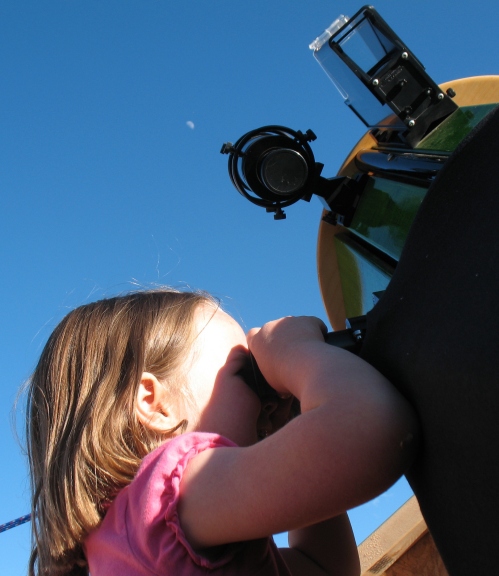
Why do I look through telescopes? Why do I keep building bigger telescopes?  Because I am stupefied with awe every time I gaze deep into the sky at the faint glow of the Veil Nebula.  Stupefied with awe at the fact that I am staring at the echo of a star’s death, light that began its journey toward Earth more than 8,000 years ago, before the beginning of recorded human history.

Preparing for a night of stargazing (left). A view of the Veil Nebula (NGC 6992, right), typical of what is seen through a telescope like that shown on the left.

Preparing for a night of stargazing (left). A view of the Veil Nebula (NGC 6992, right), typical of what is seen through a telescope like that shown on the left.

The power of the Cosmos to move people in this way is nothing new.  There are likely thousands of stories about people moved in their cores by deep contemplations of the Universe and our place in it.  Let me tell you one story, about a retired Sears Roebuck executive-turned-philanthropist named Max Adler. When he retired, Adler had heard of a new device, built by the Carl Zeiss Company in Germany, that could project a realization of the night sky on the interior of a darkened dome.  In 1928, he made a trip to see the device in action.  The visions of the night sky beguiled Adler, and he made a dedicated effort to construct the first planetarium in the Western Hemisphere.  In May of 1930, the Adler Planetarium was opened in Chicago, on the shores of Lake Michigan.  For Adler, the planetarium was a symbol to remind us that we are all part of one Universe.  He said, “In our reflections, we dwell too little upon the concept that the world and all human endeavor within it are governed by established order and too infrequently upon the truth that under the heavens everything is interrelated, even as each of us to the other.”  A different, and profound secret of life — we are the Cosmos, and the Cosmos is us.

[left panel] Max Adler with Dr. Oskar von Miller (L) and Ernest A. Grunsfeld (R) at the Deutsches Museum in Munich, where Adler first saw the Zeiss projector in action.  [center panel] The Adler Planetarium on opening day, 12 May 1930.  [right panel] The Adler Planetarium today.

[left panel] Max Adler with Dr. Oskar von Miller (L) and Ernest A. Grunsfeld (R) at the Deutsches Museum in Munich, where Adler first saw the Zeiss projector in action. [center panel] The Adler Planetarium on opening day, 12 May 1930. [right panel] The Adler Planetarium today.

The Adler Planetarium is one of the oldest and most venerable institutions for connecting people to the Cosmos in the world.  Every day, you can walk its halls and be stupefied with awe.  This week, in Chicago, they named a new president for the Adler, the ninth in an unbroken chain of leaders dedicated to beguiling people with the wonders of the Cosmos.  I’ve had the chance to talk with the new President, Michelle Beauvais Larson (President’s Page at the Adler), and must say I am beguiled by her optimism and passion for the future.  For her, the secret of life, her passion, is to do great good, and the way to do great good is to encourage people to think big thoughts. “The future of society lies in the education and imagination of its people,” she says.  Astronomy is a vehicle to inspire deep thinking; it is difficult to look deep into the Cosmos and not be struck by a sense of looking into the grandest of secrets.

Michelle Beauvais Larson, the ninth leader of the Adler Planetarium.

Michelle Beauvais Larson, the ninth leader of the Adler Planetarium.

So rejoice in the simple pleasure of seeing the world around you — sunlight sparkling through the drip of rain off your eaves, a cat’s instinctive passion for slaughtering shoelaces, the disconcerting mystery of Jan van Eyck’s Arnolfini Portrait, a child’s innocent delight with coins spinning on the floor, the full Moon rising over the city as everyone bustles home to their lives and families.  The secret of life is that we are self-aware and curious.  As collections of sentient atoms, as the Cosmos made self-aware, we can take in the world around us and revel in the simple joy of awareness and discovery, but indulge our passions and strive to comprehend.  It happens to every one of us; if it didn’t there wouldn’t be libraries, or Wikipedia, or museums and planetaria, or magazines devoted to cross stitching, or kits for building your own guitar, or telescopes you can own and set up in your own backyard.  We are wired to see and think about and rejoice in life.

In the end, I think the secret of life is not “nothing at all,” as Faith Hill concludes.  The secret of life is everything around you.  Close your laptop, turn up the music, look around, and indulge yourself.

In Living Color

by Shane L. Larson

I don’t often talk to people for great lengths of time on airplanes. I’m kind of shy around people I don’t know.  But on a recent long flight home from the East Coast, I found myself sitting next to a wonderful woman, 75 years young, and we talked for the entire 5 hour flight.  Stefi was a gold- and silversmith from Vermont, and a German immigrant.  Our conversation ranged from the art of jewelry making, to winters in Vermont, to her grandchildren whom she was going to visit in Utah.

But at some point, the conversation strayed to her childhood in Berlin, where she lived as a young girl during the closing days of World War II.  There, sitting right next to me on the plane, was a living, breathing soul who had lived through the heart of World War II.  Not a soldier, not a support person who worked the fronts or factory lines, but a person caught in the middle of the war itself. From vivid memory, she recounted tales of what she saw, living huddled in a basement with her mother and sisters as the end of the War approached.  She was there as the Red Army advanced toward the Battle of Berlin, and saw the Russian occupation of the city.  In her mind’s eye, she could see it all in living color again.  But my vision was only pale black and white; the only images of the War that anyone in my generation has ever seen are stark black and white images.

In the days after the flight, long after Stefi and I had gone back to our respective lives, I was thinking about the differences between memory and historical record. In physics, we have similar historical records of our distant past, also preserved in stark, black and white images.  One of the most famous images in my field, is of the Fifth Solvay Conference on Electrons and Photons, held in the city of Brussels in October of 1927.  The reason this particular conference is so well known is the iconic black and white photograph captured of the participants.

The participants in the 1927 Solvay Conference on Electrons and Photons, in Brussels.

Scanning through the photograph, or running your finger down a list of names, one encounters names that are completely synonymous with the development of modern physics. Of the 29 participants, 17 went on to win Nobel Prizes; included among them is Marie Curie, the only person who has ever won two Nobel Prizes in different scientific disciplines!  This single image captured almost all of the architects of modern physics.  These are the minds that seeded the genesis of our modern technological world.  The conference itself has passed into the folklore of our civilization, as this was the place that Einstein expressed his famous utterance, “God does not play dice!”  Neils Bohr famously replied, “Einstein, stop telling God what to do!”

For many of us in this game called physics, the people in this image are icons, idols, and inspirations.  We know their names, we know their stories, and we can pick them out of pictures as easily as we can pick friends out of modern pictures.  But always in the dull and muted grain of black and white photographs. I’ve never met a person (that I know of) that met Einstein, or Bohr, or Heisenberg, or Curie; no one to recount for me the vivid colors of these great minds in their living flesh.

It is an interesting fact that all of these historical images are black and white. Color photography was first demonstrated some 66 years earlier at the suggestion of another great mind in physics, James Clerk Maxwell.

The first color photograph ever taken, by Thomas Sutton in 1861 at the behest of James Clerk Maxwell. The image is of a tartan ribbon, captured by a three-color projection technique.

The process worked by taking three black and white pictures through colored filters — red, green and blue — then reprojecting the black and white pictures through the filters again to produce a colored image.  This is more or less the same principle that is used today to generate color on TV screens and computer monitors.  If you look very closely at the screen you are reading this on, you will see that the pixels are all combinations of red, green and blue.

An example of RGB image construction. The three black and white images on the left were taken through Red (top), Blue (middle) and Green (bottom) filters. When recombined through those colored filters, they produce a full color image (right).

The famous tartan picture was generated for a lecture on color that Maxwell was giving.  Maxwell’s interest in light and color derived from the reason he is famous  — Maxwell was the first person to understand that several different physical phenomena in electricity and magnetism are linked together.  His unification of the two is called electromagnetism.  One consequence of that unification was the discovery that the agent of electromagnetic phenomena is light.  Today, the four equations describing electromagnetism are called the Maxwell Equations.

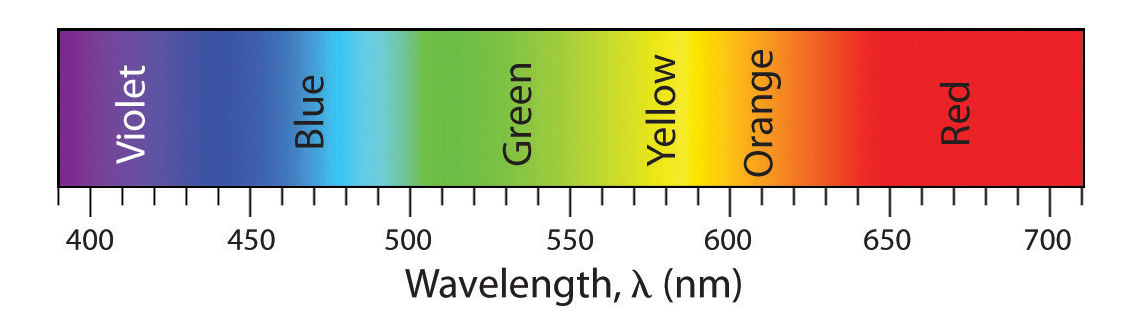
As with all things in science, the elation of discovery is always accompanied by new mysteries and new questions. One of the central realizations of electromagnetism was that light is a wave, and that the properties of the wave (the wavelength, or the frequency) define what our eyes perceive as color.

The electromagnetic spectrum — light in all its varieties, illustrated in the many different ways that scientists describe the properties of a specific kind (or “color”) of light. What your eye can see is visible light, the small rainbow band in the middle.

The realization that the color of light could be defined by a measurable property was a tremendous leap forward in human understanding of the world around us, and it naturally led to the idea and discovery that there are “colors” of light that our eyes cannot see!  Those kinds of light have often familiar names — radio light, microwave light, infrared light, ultraviolet light, and x-ray light.  But knowing of the existence of a thing (“Look! Infrared light!”) and being able to measure its properties (“This radio wave has a wavelength of 21 centimeters.”) are not the same thing as knowing why something exists.  How Nature made all the different kinds of light and why, were mysteries that would not be solved until the early Twentieth Century, by many of the great minds who attended the Solvay Conference.

Einstein famously discovered the idea that there is a Universal speed limit — nothing can travel faster than the speed of light in the vacuum of space.  Max Planck postulated that on microscopic levels, energy is delivered in discreet packets called quanta — in the case of light, those quanta are called photons.  Neils Bohr used the Planck hypothesis to explain how atoms generate discrete spectral lines — a chromatic fingerprint that uniquely identify each of the individual atoms on the periodic table. Marie Curie investigated the nature of x-ray emission from uranium, and was the first to postulate that the x-rays came from the atoms themselves — this was a fundamental insight that went against the long held assumption that atoms were indivisible, leading to the first modern understandings of radioactivity.  Louis deBroglie came to the realization that on the scales of fundamental particles, objects can behave and both waves and particles — this “duality” of character highlights the strangeness of the quantum world and is far outside our normal everyday experiences on the scales of waffles, Volkswagens and house sparrows.  Erwin Schroedinger pushed the quantum hypothesis on very general grounds, developing a mathematical equation (which now bears his name) that gives us predictive power about the outcome of experiments on the scales of the atomic world — his famous gedanken experiment with a cat in a box with a vial of cyanide captures the mysterious differences in “knowledge” between the macroscopic and microscopic worlds.  And so on.

The visible light fingerprints (“atomic spectra”) of all the known chemical elements. Each atom emits and absorbs these unique sets of colors, making it possible to identify them.

It is fashionable in today’s political climate to question the usefulness of scientific investigations, and to ask what benefit (economic or otherwise) that basic research investment begets society. Looking at the picture of the Solvay participants and considering their contributions to the knowledge of civilization one very rapidly comes to the realization that their investigations changed the world; in a way, their contemplations made the world we know today.  The discovery of radiation led directly to radiological medicine, radiation sterilization, nuclear power, and nuclear weapons.  The behaviour of atoms and their interactions with one another to generate light leads to lasers, LED flashlights, cool running lights under your car or skateboard, and the pixels in the computer screen you are reading from at this very moment. The quantum mechanical beahviour of the microscopic world, and our ability to understand that behaviour leads directly to integrated circuits and every modern electronic device you have ever seen.  That more than anything else should knock your sense of timescales off kilter; at the time quantum mechanics was invented, computers were mechanical devices, and no one had ever imagined building a “chip.”  The first integrated circuit wasn’t invented until 1958, when Jack Kilby at Texas Instruments built the first working example, 31 years after the Solvay Conference; the first computer using integrated circuits that you could own didn’t appear until the 1970s, and smartphones showed up in the early 2000’s.  The economic powerhouses of Apple, Microsoft, Hewlett-Packard, Dell, and all the rest, are founded on basic research that was done in the 1920s and 1930s.

Which brings me back to where we started — pictures from those bygone days.  After the first tri-color image of Maxwell’s tartan, the development of color photography progressed slowly. The 1908 Nobel Prize in Physics was awarded for an early color emulsion for photography, but the first successful color film did not emerge until Kodak created their famous Kodachrome brand in 1935.  Even so, color photography was much more expensive than black and white photography, and was not widely adopted until the late 1950s.  As a result, our history is dominated by grainy, black and white images.

So it was a great surprise last week when the Solvay Conference picture passed by in one of my friend’s Facebook stream, in color!  Quite unexpectedly, it knocked my socks off. I spent a good long time just staring at it.  Never before had I known of the flash of blue in Marie Curie’s scarf, Einstein’s psychedelic tie, or Schroedinger’s red bow tie (is Pauli looking at that tie with envy?).  But more importantly, the people were in color, as plain as if they were sitting across the table from me. It’s a weird twist of psychology that that burst of color, soft skin tones of human flesh, suddenly made these icons all the more real to me.

Colorized version of the famous 1927 portrait of the Solvay Conference participants.

No longer just names and grainy pictures from history books, but rather remarkable minds from our common scientific heritage, seen for the first time in living color by a generation of scientists long separated from them.

A Personal Voyage

by Shane L. Larson

Today would have been Carl Sagan’s 78th birthday.  This December, it will have been sixteen years since he left us, returned to the star stuff from whence we all came. I was first exposed to Carl in the fall of 1980, a few weeks after my eleventh birthday.  Cosmos was broadcast for the first time that fall, and my parents somehow had known to sit me down in front of our boxy television set and let me be enchanted by Carl’s poetic rapture with everything that is, or was, or ever will be.

Cosmos was not full of the dry, pithy rigidity most of us remember from our science classes.  Carl was a master of exposing the magic of science, seemingly unafraid of voicing the inner wonder that the beauty of the natural world inspires, carrying us along on his personal voyage with flair and poetic majesty.  Many of my scientific colleagues find the lyrical narrative of Cosmos annoying and disingenuous.  They feel like it belittles science, taking away some of the deep meaning of our quest to understand the secrets of Nature. But for myself, I find it exhilarating and uplifting; to this day it has the power to enchant me.  Language, like science, is one portal into the human spirit, and it is the only way by which we can communicate the wonder and mystery of the Cosmos from one person to another. It’s not grandiloquence; it’s a passionate attempt to express the deep inspiration and magic of Nature that moves us as scientists.

If there is any essential consequence of my exposure to Cosmos, it is that Carl’s voice is the voice that rings in my head when I read almost anything about science. When my profession has been boxing me soundly about the ears, or I get depressed about the state of science literacy in modern America, or I need some simple soul massage, I always turn to Cosmos.  It lifts my spirits, it reminds me of why I do this — why I do science — in the first place. In many ways, Cosmos is why I write for this blog every month.  I aspire (perhaps foolishly) to provide a mechanism for someone else to discover science, the way Carl helped me discover science.

So, in honor of Carl’s birthday, let me tell you about one small weave from the tapestry science. This is a story that evokes in me a little bit of wonder about the natural world, and astonishes me with the ingenuity of our curious young species. This is a story about how we have come to understand the bejeweled structure of matter.

One of the great wonders of modern science is that we have extended our ability to see far beyond the reach of the senses that Nature provided us through a billion years of biological evolution.  There are many places our curiosity leads us to where our biological sensors are simply not designed to work. This is the case when we peer deep into the vast reaches of the Cosmos, and it is the also the case when we peer inward to see the microstructure of the world.  In both cases, we have invented technology that allows us to see.

Suppose we look inward.  What is the matter around us made from?  How is it put together?  Are the micro properties of matter connected to the things that I can see on the scale of fuzzy bunny slippers and wine glasses and fly swatters?  Most of us at some point early in our education learn that the world is made of atoms, and learn to draw the classic picture of atoms as a dot (the nucleus) ringed by a set of ellipses threading other beady little dots (electrons).  Another axiom that we learn is that the stuff of the world is actually made from connected groups of atoms, called molecules.  How do we know that?

Crystals of table salt showing cubic symmetry (left), and snowflakes showing hexagonal symmetry (right).

That matter has underlying structure seems almost obvious when you look at some objects.  A single crystal of table salt has spectacular cubelike symmetry; snowflakes unerringly show hexagonal symmetry.  Many states of matter form themselves into regular structures that physicists call a lattice.  The exact shape and layout of the lattice depends on the properties of the atoms that make it up.  Salt crystals are made up of an alternating array of sodium and chlorine atoms.  Atoms use electrons as hooks to link themselves together (something our friends in chemistry call “valence bonds”), and where those hooks are in the atom affects the shape of molecules that include the atom.  Sodium and chlorine can link together in straight lines, and so naturally settle into a rectangular form when piled together.

A model of the lattice of table salt (sodium chloride, left) and of a water molecule (right).

By contrast, snowflakes are made from water molecules, which are comprised of a single oxygen atom bound to two hydrogen atoms.  The structure of the hooks on the oxygen atom keeps the hydrogen atoms from lying in a straight line, so the molecule ends up being bent at an angle of 120 degrees. That angle is one of the symmetry angles of a hexagon!  When you lay water molecules down together to form the ice crystal of the snowflake, they naturally take on the famous hexagonal symmetry because that is the easiest way to lay side by side.

It sounds plausible and reasonable, but how do we know this? Atoms and molecules are far too small to be seen by human eyes, but being clever students of the natural world we have learned how to use other physical phenomena as probes that are capable of teasing out mysteries that our eye cannot discern. One such phenomenon that can be exploited for this purpose is light, particularly light that we cannot see with our eyes, like x-ray light.  X-ray light is very energetic, and it can fit into very small areas (like the spaces between atoms!).  If one illuminates a material, like a salt crystal, with x-ray light, the light worms its way into the spaces between the atoms then bounces out of the crystal where it combines with x-ray light that bounces out of other parts of the crystal.  The result is a dizzying array of bright dots whose spacing and geometry are a representation of the structure of the crystal.

A single salt crystal (left) will, when illuminated with xrays, create a geometric pattern representative of the underlying crystal structure.

You can do a similar experiment at home with a CD and a laser pointer. If you shine the laser pointer on the surface of a CD and look at the reflection on the wall, you’ll see an array of dots — the spacing of those dots depends on the structure of the tracks on the CD that encode the music you listen too.

You can probe the structure of a CD using a laser pointer at home. The pattern is called a diffraction pattern.

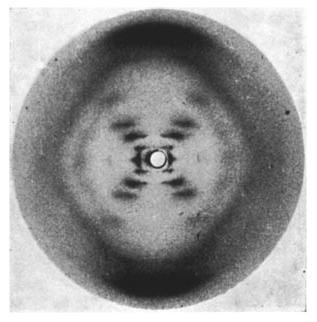
Perhaps the most famous and inspiring picture taken of matter by this technique is an image known as “Photo 51.” It was taken in 1952 by a young scientist named Rosalind Franklin and her research student, Raymond Gosling. It is the first picture ever taken of DNA, the master molecule of all life on Earth.  Before Franklin’s work, the double helix structure of DNA was unknown.

Rosalind Franklin (left) and the famous Photo 51 (right) that revealed the double helix structure of DNA.

The structure of DNA had been hinted at, but the geometry and shape were confused.  Franklin had been the first person to understand that the nucleotide bases pointed inward from the double helix spine, a fact that she had personally relayed to Francis Crick and James Watson.  Unknown to Franklin, Photo 51 had been shown to Watson, a turning point event that helped inform Watson and Crick’s  ultimate deduction of the double helix structure.  Franklin and Gosling’s paper on the structure of DNA was one of three that were published simultaneously in the journal Nature in 1953.  Franklin went on to continue her work in imaging, notably working on the characterization of the polio virus.  Sadly, she died of ovarian cancer in 1958, at the age of 37.  Watson and Crick, together with their colleague Maurice Wilkinson, were awarded the Nobel Prize in 1962 for the discovery of the structure of DNA.

Franklin’s story, like so many tales of scientific discovery, is now lost to us, taken when she died. We can’t know the wonder she and Gosling must have felt when the shadows of the double helix first emerged from their film, but we can imagine.  It is that imagining that is important now, long after the glow of discovery has faded. Imagining the simple joy of discovery after a long personal voyage; imagining those few moments when you and no one else knows some deep secret wrested from Nature.  Those are altogether human moments, when our scientific minds are flooded with endorphins and overwhelmed by the joy of discovery.  Those are the moments that we live for.